dinsdag 31 maart 2015

across the sea.

When the late French historian Fernand Braudel wrote his La Méditerranée et le Monde Méditerranéen à l'époque de Philippe II in 1949, he did something unusual. Before that, histories were written from a national perspective. Braudel wrote a history of the Mediterranean though. Indeed, the water connects - and probably even more than land does. For a long time, crossing a sea or lake by boat was a far easier task than the travel over land - over mountains and through woods full of dangers, both human and wild. In our age of cars, trains, highways, and TGV this might be difficult to imagine. Just as hard (even though it's logical) as it might be to see that history doesn't stop at a border. 

 
All these lands were once under Roman rule or influence. 


Indeed, the Roman Empire was centred around the Mediterranean - which was dubbed Mare nostrum after all. This made the British, Germanic and Northern Gallic provinces over here a periphery. When their link with a transalpine centre in the fourth century broke, however, they naturally reconnected over the North Sea. Germanic tribes migrated to Northern Gallia and Southern Britain. Frisians traded and fished up to Scandinavia. Wool of British sheep was processed in Flanders and Holland. Britons went for study to Paris. And it wasn't a surprise that it was coastal trading towns from the Baltics to England - but mainly from Northern Germany - that united in the Hanseatic League. 


As much as we are used to the idea of a sea that divides, it is striking how many of them don't. In many ways - history and economy for example, the Southern US shares more with the Caribbean than with the Great plains. The Southern Caucasian state of Azerbaijan is regarded at times part of Central Asia, with which it shares authoritarianism apart from an oil-dependent economy.


Connected by more than pipelines? Not only Azerbaijan, but basically 
all Caspian littoral states are oil dependent dictatorships. 


Both Ukraine (2004, 2013) and Georgia (2003) revolted against the mafiose Post-Soviet structures in their countries, and they subsequently even proposed a 'Black Sea Union'. Ukraine and Georgia bonded that much that currently many former Georgian revolutionaries serve in the Post-Maidan administration in Ukraine. Georgia looking West - over the Black Sea towards the European Union, and Azerbaijan looking East - over the Caspian towards Central Asia, suddenly sounds a lot more plausible. 

The Black Sea is surrounded by real (Turkey, Greece, Romania, Bulgaria) 
and would-be (Ukraine, Georgia) NATO members.

At the moment, we see how Egypt's Vietnam (Yemen) is just accross the Red Sea and how the Persian Gulf simultaneously holds Iran and Saudi Arabia in a deadly embrace. Yes, the more I look at my maps, the more they look like this:

zaterdag 31 januari 2015

when one turns two.

This year, I was lucky to spend Christmas and New Year with minus 26 high up in Northern Sweden. There, I spend some time with a Finnish-speaking family. I hear you thinking, and I thought as well: what are Finnish-speakers doing in Sweden, why don't they move to Finland, or why isn't their home part of it? Obviously, I started to read and this is what I found out. 


These Swedish Finnish-speakers are separated from their co-speakers since Finland became a part of the Russian Empire. Before, there was no border, and there was no Finland: all was Sweden. In 1809, the Treaty of Fredrikshamn (Hamina) ended the Finnish War (1808-9) between Sweden and Russia. It created two nations where there was only one before.


Large parts of present day Finland had become part of the Swedish realm in the fourteenth century. Finnish speaking people are living in the Swedish Torne valley since at least this day. Therefore, they are known as Tornedalians. At times, they were instrumental in the colonization of Northern Sweden. When the Russian Empire acquired present day Finland in 1809, the Tornedalians were not included, although the Russians pushed for it. Until after the 1950s the Swedish government tried to Swedify the Tornedalians. Since then, the policy was reversed, and in 1999 the Tornedalian language, Meänkieli, was officially recognized as a minority language. It is said that there's still about 150,000 Swedes who understand Meänkieli. Many of the developments of standard Finnish in the nineteenth and twentieth century didn't happen in the Meänkieli dialect. Moreover, it contains many Swedish loanwords. As such, a new nation with a distinct language is created.

There's also many Finns in Sweden, by the way, but they find their origin in what is now Finland. The Swedes in Finland settled there ages ago (since 1200), but as a matter of fact, they don't see or at least call themselves different than the Swedish Swedes. In Norway there's Finnish speaking people known as Kven.


Finnish is a Finno-Ugric language, as Hungarian is famously as well. These are not all of them, however. In Northern Russia there's many more Finno-Ugric speakers. Read more about this here. 


There's more examples of a divided nation which becomes or might become two - or more. For example, the Turks (Turkey and Azerbaijan), the Azeri (Azerbaijan and Iranian Azerbaijan), the Arabs (Syria, Iraq, etc.), the Bulgarians (Macedonia, Bulgaria), the Albanians (Kosovo, Albania), Mongolians (Inner and Outer Mongolia), Bengali (Bengal and Bangladesh), etc. Of course, it's all about identification. Even though many Arab dialects aren't mutually intelligible, many speakers see Arab as one tongue. And what about the Korea's, or the Pashtun in Pakistan and Afghanistan? The Germans were never together in one state, but what is it that separates Swiss, German Germans and Austrians? And what would have happened if the German Democratic Republic would have lived on? More people today identify with Meänkieli, but almost nobody without abandoning their Swedish identity. A feeling which is stronger, obviously, than the language bond with Finland. 

donderdag 4 december 2014

Mongolia as SSR.

Last week, I wrote ‘the gloves are off’. Indeed, I would argue that, with the cancelling of the South Stream gas pipeline project, the conflict Russia has with many of its neighbours - including the EU, entered a new phase. The move shows that the Russian leadership is willing to abandon its strongest leverage towards Europe: gas. Simultaneously, something else happened, which was covered less: a remarkably deep new pact between the Russian Federation and the Republic of Abkhazia – including military cooperation. Although Russia recognized the independence of this Georgian breakaway region in 2008, many see this move as the prelude to a future annexation. In 2008, many would have regarded this exaggerated, but since Ukraine lost Crimea in March, everything seems possible. However, Russia doesn’t need to. With its formidable army, size and status, it is able to project quite some power without annexing anything. Abkhazia is an example, as are Transnistria in Moldova, Nagorno-Karabakh in Azerbaijan, and South Ossetia in Georgia  - and the considerable Russian minorities in Eastern Ukraine, Northern Kazakhstan, Estonia, Latvia and Belarus furthermore. The case of Mongolia is in that regard an interesting one, and one I wanted to delve into for quite some time.

Some time ago, in that peaceful time long gone when Crimea was simply Ukrainian and Armenia was eager to be the next member of the Eurasian Economic Union, I joked with my friends that Mongolia might be the next republic in the Russian Federation. Russia, as what’s left from the USSR, consists of 22 federal republics (including Crimea since March). Three of them, Kalmykia, Buryatia and Tuva, are inhabited by ethnic Mongols. One more makes little difference, wouldn’t it? Increasingly threatened by an more and more expansionist China to its South, joining its enemy enemy might be the only way to survive. We all know it didn’t happen. However, with the tension around the South China and Black Seas, it seems a miracle that none of the big powers tried to court Mongolia more explicitly. Most probably, it’s still beneficial for both China and Russia to let Mongolia be, and maintain its neutral status squeezed in between the two authoritarian powerhouses.

The Federal Republics in the Russian Federation inhabited by ethnic Mongols: Kalmykia, Tuva and Buryatia. 

As we speak, there is talk that Mongolia might join the Shanghai Cooperation Organization. The SCO is a club of mainly Post-Soviet countries plus China, established in 1996 to settle border disputes in the heart of Asia, but increasingly helping each other out to streamline regime security and the fight against terrorism. Mongolia is an observer state since 2004. The question is though, if the wish to join is cherished more in Beijing than in Ulaanbaatar. Most Mongols, including in government, see the SCO as a China-dominated club of authoritarian regimes. This image is the opposite of Mongolia’s: democratic and carefully manoeuvring in between Russia, China and the USA – the so-called ‘third neighbour’ policy. (There’s few other examples. Nepal and Bhutan are also stuck in between big powers, but they seem to have chosen for India.) Moreover, apart from its SCO observer status, Mongolia has an ‘Individual Partnership and Cooperation Program’ with the NATO, and it delivered troops to the NATO missions in Kosovo and Afghanistan. Mongolia continuously needs to balance its foreign policy act.

Mongolia and the Mongols: in red the places inhabited by ethnic Mongols, and accentuated the boundaries of the Medieval Mongol Empire. 

Outer Mongolia, conscious of Ming China’s policies in Inner Mongolia, looked at the Russian Empire to counter Chinese colonization efforts. Shortly after the Outer part of Mongolia became independent in 1912, it signed a Friendship Treaty with the Russian Empire, and subsequently Russian settlers arrived. China, now a republic as well, continued to meddle in Mongolian affairs. Russian presence in Mongolia continued to grow, however. During the Civil War that followed the October Revolution from 1918 to 1922, many ‘White’ Russian fled to Mongolia, and stayed. However, the Reds won, and two years later, in 1924, Communists took power in Mongolia as well. As the powers in Mongolia got even more cosy with Moscow, a new wave of immigrants followed: Soviet specialists and advisers. The Soviet Union encouraged cross-border contact, especially between areas populated by ethnic Mongols in the Soviet Union. In 1944, the Mongol-inhabited Tuva republic was annexed by the Soviets, but Mongolia kept its independence.

The Soviet Union expansion during and around the Second World War. 

During the Second World War, Mongolians fought the Japanese side to side with the Soviets (and even under their formal command). As a result, China recognized Mongolia’s independence finally, in 1945 – but under protest. After its establishment in 1949, the People’s Republic of China directly recognized Mongolia’s independence, but relations neither got that warm. After the Sino-Soviet Split in 1960, Mongolia firmly chose the side of the USSR. In 1986, as a result of Gorbachev’s ‘New Thinking’, the relationship between China and the Soviet Union improved. It was even proposed to withdraw the Soviet troops from Mongolia. Of course, this alarmed the Mongolian leadership. To reassure them, the Soviets explicitly stated the obvious - that ‘no third countries should be harmed.’ In the end, not all Soviet troops were withdrawn from Mongolia. Anyway, the Mongolian leadership established ties with the US in 1987. A ‘third neighbour’ was created.

Mongolia abandoned Communism in 1990, but the re-branded Socialist Party only lost power in 1996. Contrary to many Post-Soviet states, the Russians of Mongolia nowadays speak Mongolian. There’s only 1600 left of the 110.000 that lived there before 1992. Like in Georgia, English replaced Russian as ‘the language of inter-ethnic communication’ – and as the gate to the outside world. When the Soviet Union fell apart, the Mongolian-Russian trade plummeted, and the business contact with China rose simultaneously. However, even though the relationship between the three neighbours is more balanced than before, the Russian continue to maintain their strong ties with Mongolia.

zondag 23 november 2014

Mingrelian mourning.

Eastern Georgia is the home of the Mingrelian people. At times, Mingrelians are called 'the Jews of Georgia'. With both Europe and the Middle East at reasonable distance, this shouldn't be mistaken as anti-Semitism. Actually, Georgia is a good friend of Israel internationally. As such, the label 'Jew' can even be seen as a compliment. However, Georgians from the Eastern regions call them untrustworthy and cunning as well - or even sly. But, how come? Traditionally, the Mingrelians are traders.

 
Trading in Megruli. 

I am fascinated by cross-border communities as the Mingrelians. It is striking how many of them - Armenians, Lebanese, Tuareg, Dutch (?) - are involved in trading (without being particularly affluent per se, by the way). People from peripheral regions seem to fulfil a middle-man position. 

Indeed, the capital of Samegrelo, Zugdidi, is not exactly what you would call a thriving trade centre (although I do love the place). 

Mingrelian is related to Kartuli, the main Georgian language, but the languages aren't mutually intelligible. The Mingrelians inhabit both the region stretching from the Caucasus mountains to the Black Sea, Mingrelia or Samegrelo, and parts of Abkhazia, the region further West along the coast. Abkhazia is de facto independent since 1993, when it fought a short separatist war with Georgia (see earlier posts).

Another view of Zugdidi. 

Many of the Abkhaz Mingrelians where expelled from Abkhazia during and after the war, as they were seen as Georgians (and many see themselves as such indeed) - but some of them stayed. Mingrelian surnames tend to end in -ia, -aia, -a, and -ava - just like many the names of ethnic Abkhaz do. In a territory where there is many inter-ethnic marriage, and where the language of day-to-day communication is Russian anyway, it is often rather difficult to differentiate between Mingrelians and Abkhaz. Furthermore, many of the government jobs are reserved for ethnic Abkhaz. Since 1993 in particular, it's quite beneficial to register as an Abkhaz, therefore. (When Abkhazia was under control of the Georgian state, many Mingrelians were registered as Georgians, for the same reasons.)

A typical Mingrelian house, both in rural and residential areas. 

Characteristic for Samegrelo are the two-storied detached houses surrounded by a large, green, fenced yard full of palm trees (and if you're lucky apricots, tangerines, pears, etc.). All houses have an elevated veranda. Often there's water tanks on a high platform. Houses are strikingly often painted in mint green, by the way.

A front door with the characteristic mint green plaster. 

As the Likhi mountain range divides Georgia in two, the Western part of Georgia was often separated from it's East. The Greek, Roman, Byzantine, and Ottoman empires had a bigger influence here than in Karli and Kakheti (there it was Persians before and Persian after). Only during Russian and Soviet rule both parts were properly unified again since long. Konstantin Gamsakhurdia, the poet father of Zviad Gamsakhurdia, the first President of independent Post-Soviet Georgia, was from Abasha in Samegrelo. Therefore, the support for Zviad was higher in Samegrelo than elsewhere. However, Zviad was a Georgian nationalist. Not all Mingrelians feel that Georgian though. When I was around, it happened several times that the ubiquitous toast 'Gaumarjos Sakartvelos!' (Long live Georgia!) was replaced with 'Samegrelos gaumarjos!'

The yard and the colour are typical Mingrelian - the architecture less.

Traces of the different past of Western Georgia can be found in the existence of milk kinship, for example. Milk kinship is also present in many Muslim societies. However, just like the Georgians, Mingrelians are Christians for centuries. They are Georgian-Orthodox. Therefore, the literary language of the Mingrelians is Kartuli (Georgian), and and attend church service in Georgian. However, like anywhere, many pre-Christian rituals are preserved. It wouldn't surprise you that liquor is involved in many of them, even during funerals and the subsequent mourning process.

A funeral company in Zugdidi. 

Mingrelians mourning is quite ritualized. Libation or drinking offerings are part of this. It's fairly common to see small glasses of wine or liquor on a gravestone. Sometimes there's grapes as well - or even flowers. During the visiting of the body, a banquet for close kin is organized - although the food shouldn't be prepared in the same house. Night wakes last for four to six days. The women in particular scream, howl and sing polyphonic songs. Forty days later and a year later again, commemorate feasts are held. During these commemorations, food, drinks and candles are put on the grave. Interestingly, it is also tradition for male relatives to not shave on Saturdays for a year after the deceasing of their family member.

A grave stone with drink offering.

zondag 19 oktober 2014

one day in the life of a small crossing.

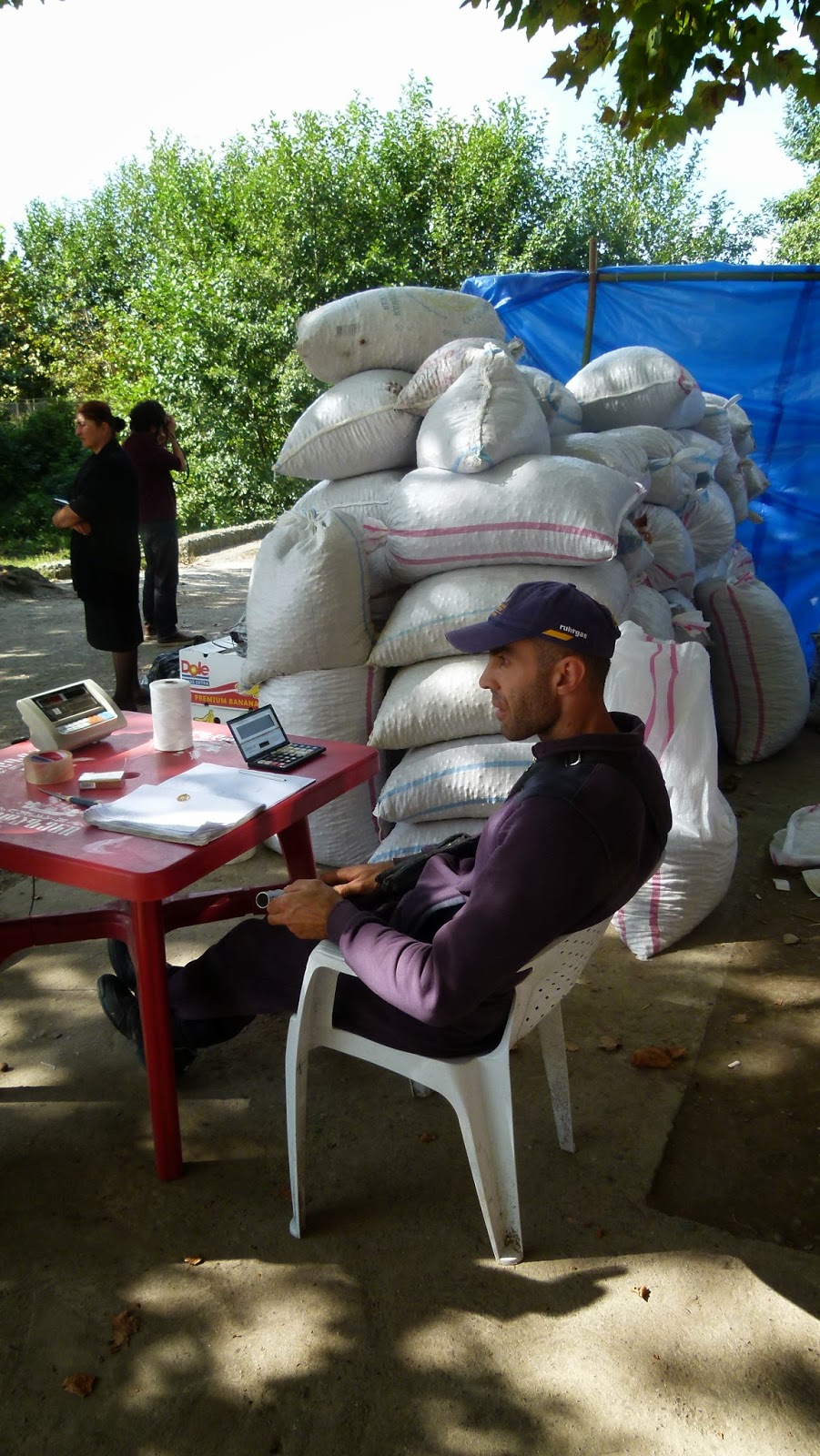
As a contrast to the big Enguri crossing, we visited one of the five smaller ones that provide an entry point into Abkhazia as well. Here you see some pictures of the Khurcha crossing, near the village of Orsantia. The five 'small' crossings are mainly used for trade and family visits. It is the time of the hazelnut harvest, and since Nutella and Ferrero Rocher discovered the riches of the Black Sea shores recently, business is booming. Nuts are brought from Abkhazia, and sold to the Georgian traders who are in contact with international buyers. It is said that annually twenty tons hazelnuts are crossing the ABL (the administrative boundary line, yes).


Apart from the all the nutty business, the crossing seemed a quiet place.  


It turned out the Russian border guards, probably conscripts, were as curious for us, as we were for them. 


There was something of a Wild West atmosphere, with lots of cigarettes, motor bikes and wodka. 

Talking about cigarettes: you probably find this type of claw machines only in Georgia. Imagine, and this particular one was placed at a remote border crossing! 


Georgians who cross are usually able because they got hold of certain documents. If you don't have the right documents, no crossing. As simple as that, even when you live there your whole life and even if everybody knows your mum lives in the next village. 

There's different 'right' documents. One type is an old Soviet passport. It turned out they are still useful, at least at the Georgian-Abkhaz ABL. During Soviet times, a passport was valid for life, and with pictures taken only during your childhood, twenties and fourties, some old people still manage to use them to cross with. 

Another way is an Abkhaz passport. With the 'international' version, you're able to travel to Russia, Venezuela, Nicaragua and Nauru, the only countries recognizing the Abkhaz state obviously. If you, as an ethnic Georgian, happen to carry a Georgian passport as well, there won't be any trouble crossing back-and-forth (although the Georgians officially say you're crossing nothing - you just move around in Georgia). Carrying an Abkhaz passport is a sensitive topic for ethnic Georgians though, which makes it a tricky strategy.
 

There's also an Abkhaz 'internal' passport. There's no big difference with the international one though, but with this one you can't travel to South America or the Pacific. Note that most Abkhaz inhabitants also carry a Russian passport, which they use for the biggest chunk of the usual passport stuff.

woensdag 15 oktober 2014

How I managed to get broke in Abkhazia and why this might be interesting for you.

During the last two weeks, I strolled around in the part of Georgia where the provinces of Samegrelo and Abkhazia meet. Both have stunning scenery and fastastic people, among other things. However, what makes this place most intesting is that Abkhazia isn't ruled by Tbilisi any more since 1993. Abkhazia is a so-called 'de facto state', and the Georgian-Abkhaz war is a 'frozen conflict'. From 1992 to 1993 Abkhazia fought a separatist war, and with help of a broad variety of foreign fighters, including Russian soldiers (but also Chechens and other North Caucasians), Abkhazia has been de facto independent onwards. As a result of the August War of 2008, in which Russia and Georgia fought five days over one of this other unruly regions of Georgia, South Ossetia, Abkhazian independence was recognized by the Russian Federation, Venezuela, Nicaragua, Nauru, and Hamas. 

However, the boundary between the Abkhaz and Mingrelian provinces can't be called a border. Borders deliniate states, and most countries in the world don't see Abkhazia as a state. The EU therefore calls the dividing line the 'ABL' - Administrative Boundary Line. To make things more complicated, there's ethnic Georgians living on both side of it. In fact, the villages you enter directly after crossing the ABL into Abkhazia are basically hundred percent Georgian populated. Naturally, the people on both sides have strong bonds, whether personal, economic, or else. But at times, there's many obstacles. The Russian Army, which is manning the border posts (the Abkhaz aren't able), doesn't always let everybody cross. Their power to let people cross or not, is a very strong tool in the power politics of the Caucasus. 

To get an idea what was happening in reality, during the day-to-day life of an average gray zone inhabitant, we visited many places and spoke to quite a few people. There's five 'small' crossings of the ABL, mainly used for trade and family visits. The main crossing is Enguri bridge. As the Georgian consider Abkhazia part of their state, obviously, their checkpoint pretends to be a 'normal police' one, with no real checks, apart from an occasional chat if they beckon you. 


It seems as if there's considerable price differences between the Georgian and Abkhaz sides of the border, as everybody around was carrying big bags as after a day of shopping. When you cross the Georgian checkpoint, you enter the 'border' area. The Enguri bridge itself is badly maintained, and not used by much more than pony carts used to carry the heavy bags. 

For most of the ABL, the Enguri river forms the boundary between Samegrelo (Georgia) and Abkhazia. 

The Abkhaz tried hard to make the entry to their side look like a real state border, and did so with some help of the Russian Army border guards. We had to show our passport twice, hand in an official clearance, go trough the customs with our rucksacks, and answer some questions. The Russian conscripts didn't know Latin script though, so, as our clearances were in Cyrillic, and our passports in Latin, this took some time. The guards were friendly though, and were willing to compare the size and number of inhabitants of Abkhazia and the Netherlands, for example. Thereafter, we entered Abkhazia properly, and we were welcomed by some billboards commemorating Victory Day last week, an enormous Abkhaz flag, and some empty marshrutkas. It turned out most of the border crossers were picked up by relatives or friends, and public transport became a problem. 

We had to take a taxi, and for 300 rouble (about $10) we were brought to Gali, the main town in the Georgian populated part of Abkhazia. This was six times more than budgetted, but, worse, soon we discovered that travelling from Gali to Sokhumi wasn't easy either. There was only one, lonely marshrutka, staying suspiciously empty for one-hour-and-a-half. The marshrutka was twice as expensive as the internet had informed us before: 200 rouble (or $7). A taxi would have been $50.


This is NGO street, by the way. UNHCR, Danish Refugee Council and World Vision manage to keep field offices in Gali. Gali was a lot bigger than I expected, more livelier also, but it wasn't a happy place. Obviously, this was were most of the war was fought in the nineties, and this place probably isn't high on the reconstruction priority list of the government in Sokhumi, the Abkhaz capital hundred kilometres away. On the way to Sokhumi, most buildings were abandoned and few maintained. Fields weren't kept either. Abkhazia lost half it's population during the war, and this was still obvious.


After an hour drive we arrived in Sokhumi. We needed to get there, because without a visum, we couldn't leave the territory. In the 48 hours after entering Abkhazia you need to travel to the capital to take and pay for your visum. We managed to find the Ministry of Foreign Affairs at 21 Ulitsa Lakoba, but we were directly send to the Consular Office, at 33 Ulitsa Sakharova. 


At the Consular Office, we had to show our clearances again (happy we printed double), and we got our visum, on a separte paper. Probably this is not to accomodate the Georgian authorities, but to enable foreign visitors to keep their passport. As most states don't recognize Abkhazia, they don't recognize it's visa either. A visum was $10 (to be payed in US dollar), but they didn't have change. Going to a bank, split our $50 note, pay the fee (twice $2), and get a receipt (welcome in the Post Soviet sphere) was the least we could do. 

In comparison with the rest of Abkhazia, Sokhumi was an oasis. There were green palm trees everywhere, along the broad lanes for example, and every square meant in fact a small park. The buildings were painted and the Black Sea was never far away. It doesn't surprise my that half the Soviet Union travelled here to celebrate holidays, although - for a Dutchman - the type of beaches here continue to be a wee meagre. This is the boulevard.


Some things doesn't seem to have changed since the Battle of Sokhumi in 1993, and the abandoned harbour right in front of the boulevard was one of them, the gigantic Abkhaz flag on top notwithstanding. 

The Psou river crossing to the Russian Federation and the Enguri river crossing into Georgia proper are both about 120 kilometres from Sokhumi. Abkhaz generally don't understand why Westerners tend to enter via Georgia, but when I explained, all was clear. Taking a marshrutka  back and arrive in time (before the ABL closes at seven) wasn't that easy, however. Whilst Tbilisi is always, everywhere, boiling over with taxis, marshrutkas and other possible ways of transport, Sokhumi wasn't. We found exactly three taxi drivers in an hour. Moreover, we had only 1800 rouble ($60) left, and yes, there weren't ATMs. It turned out the trip back would be 2000 rouble (that's a small, but significant difference, it turned out). One of the taxi drivers didn't want to do it for the money we had left, the second one was piss drunk, and the third one was amazing, the best driver I met around here since now. It was a pity his eye sight was so bad, and he was kinda deaf (the music was nice, but just very much too loud). Himself an ethnic Abkhaz, his wife was Georgian, so he told about his mother-in-law in Georgia, his brothers-in-law in Gali, and his dacha in Ochamchire. Time flew, and here we're already crossing the Olori.


If you take a taxi or marshrutka from Sokhumi to the ABL, it takes at least one-hour-and-half. To Gali, it's an hour, and then it's still about fifteen kilometres. Since there's so few marshrutkas leaving Gali, and since Gali is the last place you want to be stuck after five o'clock, make sure you have transport to the Enguri bridge. In contrast to Georgia, there's high levels of criminality here, and you can't cross into Georgia proper after seven. Waiting in Gali until it's the next morning is not advised. 


Since we found a broad variety of stories, tales and myths online and on print, I share our own experience. I hope it helps you, one day, any time. 
  • Don't go in the weekend, because the Consular Office will be closed. It's a pity, since this unables you to travel to Abkhazia if you're working during the week in Georgia. If so, only Friday afternoon or Monday morning are options. 
  • From the centre of Zugdidi, you can take a marshrutka to the Enguri bridge for 1 lari ($0,50). A taxi is 10 lari ($5). 
  • You can't assume that there's marshrutkas at either the Abkhaz side of Enguri bridge, or in Gali, so take enough roubles with you. A taxi to Gali is 300 rouble, and from Gali to Sokhumi it's 1500. A marshrutka from Gali to Sokhumi leaves about every hour (but maybe two), and costs 200 rouble, not 100. It takes an hour. At the moment $1 is about 30 rouble.
  • There's no need to look for the Ministry of Foreign Affairs. Go directly to the Consular Office, 33 Ulitsa Sakharova. 
  • Visa are $10. They don't have change, but that doesn't matter, since it's half as cheap as we thought. 
  • There's only one ATM in Abkhazia where you can use your Western Maestro or Visa cards. It's at the Sber Bank, 1 Plochad Konstitutsiy. 
  • Go back in time. The drive from Sokhumi to Enguri takes at least one-hour-and-a-half, if you're lucky and if you take a taxi. If you take a marshrutka to Gali and a taxi to the ABL, it will take at least two hours. And the ABL closes at night. After seven, you're stuck in a place you don't want to. 
 I do have to admit though, that the Enguri is price-less at that time of the day.